Howdy! Welcome to my home page.👋
I am a third-year M.S. student at Xidian University, advised by Prof. Bo Chen.
Currently, I am a Research Intern at Stony Brook University, working with Prof. Chenyu You.
Also, I work closely with Prof. Stefanie Jegelka and Yifei Wang on developing efficient and scalable sparse methods.
Prior to my graduate studies, I received my B.S. degree from Xidian University in 2023.
🔥 I am seeking for PhD position in 26Fall in US.
Please feel free to reach out to me via email if you believe I am a good fit for your research team.
I welcome the opportunity for further discussion! Please see my
CV for more details.
Research Interests
My primary research goal is to develop scalable, reliable, and efficient methods for machine learning and generative AI, with a particular focus on sparsity, adaptive representation learning, and principled uncertainty estimation in foundation models—including LLMs, VLMs, and diffusion models. In addition, I am also highly interested in:
📚 Memorization in large models
🔄 Self-consuming/self-improving loops
🤖 Agent learning with Foundation models
If you share the same research interests, feel free to reach out or add my
Wechat
🚀🚀 News
[10/2025] Join ByteDance Bandai as a Research Intern, targeting Deep Research!⚡️️⚡️
Many large-scale systems rely on high-quality deep representations (embeddings) to facilitate tasks like retrieval,
search, and generative modeling.
Matryoshka Representation Learning (MRL) recently emerged as a solution for adaptive embedding lengths, but it
requires full model retraining and suffers from noticeable performance degradations at short lengths.
In this paper, we show that sparse coding offers a compelling alternative for achieving adaptive representation
with minimal overhead and higher fidelity.
We propose Contrastive Sparse Representation (CSR), a method that sparsifies pre-trained embeddings into a
high-dimensional but selectively activated feature space.
By leveraging lightweight autoencoding and task-aware contrastive objectives, CSR preserves semantic
quality while allowing flexible, cost-effective inference at different sparsity levels.
Extensive experiments on image, text, and multimodal benchmarks demonstrate that CSR consistently
outperforms MRL in terms of both accuracy and retrieval speed-often by large margins-while also cutting
training time to a fraction of that required by MRL.
Our results establish sparse coding as a powerful paradigm for adaptive representation learning in real-world
applications where efficiency and fidelity are both paramount.
Mixture-of-Experts (MoE) architectures scale large language models (LLMs) by activating
only a subset of experts per token, but the standard TopK routing assigns the same
fixed number of experts to all tokens, ignoring their varying complexity. Prior adaptive
routing methods introduce additional modules and hyperparameters, often requiring costly
retraining from scratch. We propose Sequence-level TopK (SeqTopK),
a minimal modification that shifts the expert budget from the token level to the sequence
level. By selecting the top T × K experts across all T tokens, SeqTopK enables
end-to-end learned dynamic allocation -- assigning more experts to difficult tokens and
fewer to easy ones -- while preserving the same overall budget. SeqTopK requires only a
few lines of code, adds less than 1% overhead, and remains fully compatible with pretrained
MoE models. Experiments across math, coding, law, and writing show consistent improvements
over TopK and prior parameter-free adaptive methods, with gains that become substantially
larger under higher sparsity (up to 16.9%). These results highlight SeqTopK as a simple,
efficient, and scalable routing strategy, particularly well-suited for the extreme sparsity
regimes of next-generation LLMs.
In the era of large foundation models, the quality of embeddings has become a central determinant of downstream task performance and overall system capability.
Yet widely used dense embeddings are often extremely high-dimensional (e.g., 4096), incurring substantial costs in storage, memory, and inference latency.
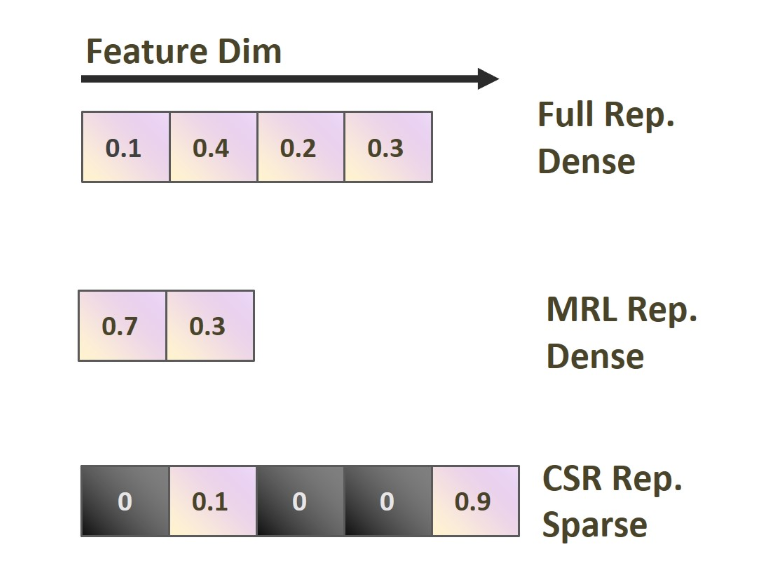
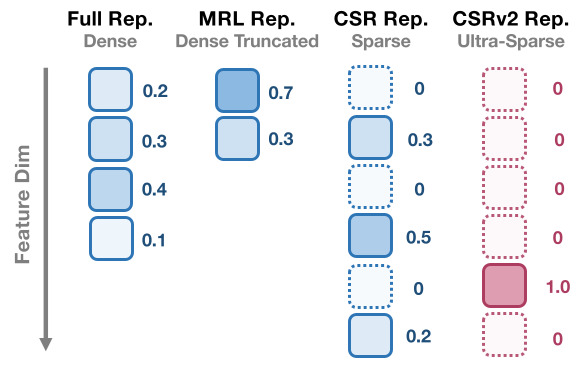
To address these, Contrastive Sparse Representation (CSR) is recently proposed as a promising direction, mapping dense embeddings into high-dimensional but k-sparse vectors, in contrast to compact dense embeddings such as Matryoshka Representation Learning (MRL).
Despite its promise, CSR suffers severe degradation in the ultra-sparse regime (e.g., k ≤ 4), where over 80% of neurons remain inactive, leaving much of its efficiency potential unrealized.
In this paper, we introduce CSRv2, a principled training approach designed to make ultra-sparse embeddings viable.
CSRv2 stabilizes sparsity learning through progressive k-annealing, enhances representational quality via supervised contrastive objectives, and ensures end-to-end adaptability with full backbone finetuning.
CSRv2 reduces dead neurons from 80% to 20% and delivers a 14% accuracy gain at k=2, bringing ultra-sparse embeddings on par with CSR at k=8 and MRL at 32 dimensions, all with only two active features.
While maintaining comparable performance, CSRv2 delivers a {7× speedup over MRL}, and yields up to 300× improvements in compute and memory efficiency relative to dense embeddings.
Extensive experiments across text (MTEB, multiple state-of-the-art LLM embeddings (Qwen and e5-Mistral-7B)) and vision (ImageNet-1k) demonstrate that CSRv2 makes ultra-sparse embeddings practical without compromising performance.
By making extreme sparsity viable, CSRv2 broadens the design space for large-scale, real-time, and edge-deployable AI systems where both embedding quality and efficiency are critical.
Concept-based models can map black-box representations to human-understandable concepts,
which makes the decision-making process more transparent and then allows users to understand the reason behind predictions.
However, domain-specific concepts often impact the final predictions, which subsequently undermine the model generalization capabilities, and prevent the model from being used in high-stake applications.
In this paper, we propose a novel Language-guided Concept-Erasing (LanCE) framework.
In particular, we empirically demonstrate that pre-trained vision-language models (VLMs) can approximate
distinct visual domain shifts via domain descriptors while prompting large Language Models (LLMs) can easily
simulate a wide range of descriptors of unseen visual domains. Then, we introduce a novel plug-in domain
descriptor orthogonality (DDO) regularizer to mitigate the impact of these domain-specific concepts on the
final predictions. Notably, the DDO regularizer is agnostic to the design of concept-based models and we
integrate it into several prevailing models. Through evaluation of domain generalization on four standard
benchmarks and three newly introduced benchmarks, we demonstrate that DDO can significantly improve the
out-of-distribution (OOD) generalization over the previous state-of-the-art concept-based model.
Factor analysis, often regarded as a Bayesian variant of matrix factorization,
offers superior capabilities in capturing uncertainty, modeling complex dependencies,
and ensuring robustness. As the deep learning era arrives, factor analysis is receiving
less and less attention due to their limited expressive ability. On the contrary,
contrastive learning has emerged as a potent technique with demonstrated efficacy
in unsupervised representational learning. While the two methods are different paradigms,
recent theoretical analysis has revealed the mathematical equivalence between contrastive
learning and matrix factorization, providing a potential possibility for factor analysis
combined with contrastive learning. Motivated by the interconnectedness of contrastive
learning, matrix factorization, and factor analysis, this paper introduces a novel
Contrastive Factor Analysis framework, aiming to leverage factor analysis's advantageous
properties within the realm of contrastive learning. To further leverage the interpretability
properties of non-negative factor analysis, which can learn disentangled representations,
contrastive factor analysis is extended to a non-negative version. Finally, extensive
experimental validation showcases the efficacy of the proposed contrastive (non-negative)
factor analysis methodology across multiple key properties, including expressiveness,
robustness, interpretability, and accurate uncertainty estimation.
Image captioning evaluation metrics can be divided into two categories, reference-based metrics and reference-free metrics. However, reference-based approaches may struggle to evaluate descriptive captions with abundant visual details produced by advanced multimodal large language models, due to their heavy reliance on limited human-annotated references. In contrast, previous reference-free metrics have been proven effective via CLIP cross-modality similarity. Nonetheless, CLIP-based metrics, constrained by their solution of global image-text compatibility, often have a deficiency in detecting local textual hallucinations and are insensitive to small visual objects. Besides, their single-scale designs are unable to provide an interpretable evaluation process such as pinpointing the position of caption mistakes and identifying visual regions that have not been described. To move forward, we propose a novel reference-free metric for image captioning evaluation, dubbed Hierarchical Image Captioning Evaluation Score (HICE-S). By detecting local visual regions and textual phrases, HICE-S builds an interpretable hierarchical scoring mechanism, breaking through the barriers of the single-scale structure of existing reference-free metrics. Comprehensive experiments indicate that our proposed metric achieves the SOTA performance on several benchmarks, outperforming existing reference-free metrics like CLIP-S and PAC-S, and reference-based metrics like METEOR and CIDEr. Moreover, several case studies reveal that the assessment process of HICE-S on detailed captions closely resembles interpretable human judgments.
Our code is available at https://github.com/joeyz0z/HICE.
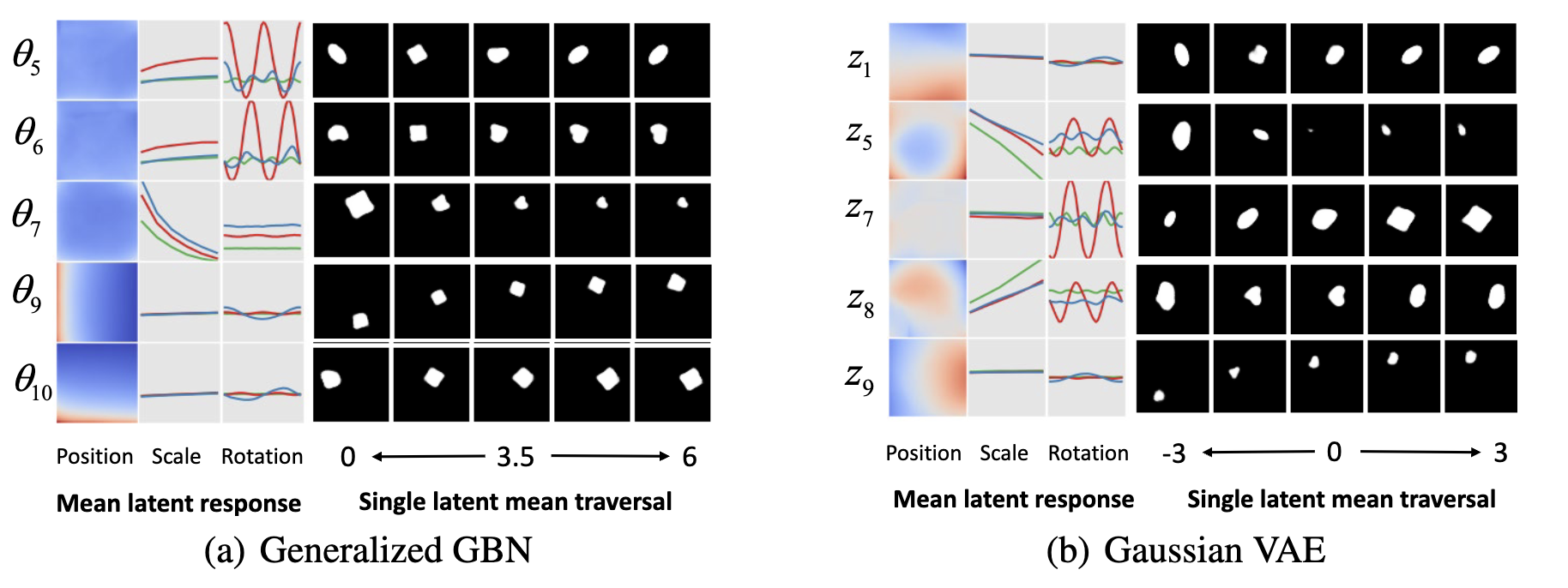
The gamma belief network (GBN), often regarded as a deep topic model, has demonstrated its potential for uncovering multi-layer interpretable latent representations in text data. Its notable capability to acquire interpretable latent factors is partially attributed to sparse and non-negative gamma-distributed latent variables. However, the existing GBN and its variations are constrained by the linear generative model, thereby limiting their expressiveness and applicability. To address this limitation, we introduce the generalized gamma belief network (Generalized GBN) in this paper, which extends the original linear generative model to a more expressive non-linear generative model. Since the parameters of the Generalized GBN no longer possess an analytic conditional posterior, we further propose an upward-downward Weibull inference network to approximate the posterior distribution of the latent variables. The parameters of both the generative model and the inference network are jointly trained within the variational inference framework. Finally, we conduct comprehensive experiments on both expressivity and disentangled representation learning tasks to evaluate the performance of the Generalized GBN against state-of-the-art Gaussian variational autoencoders serving as baselines.